
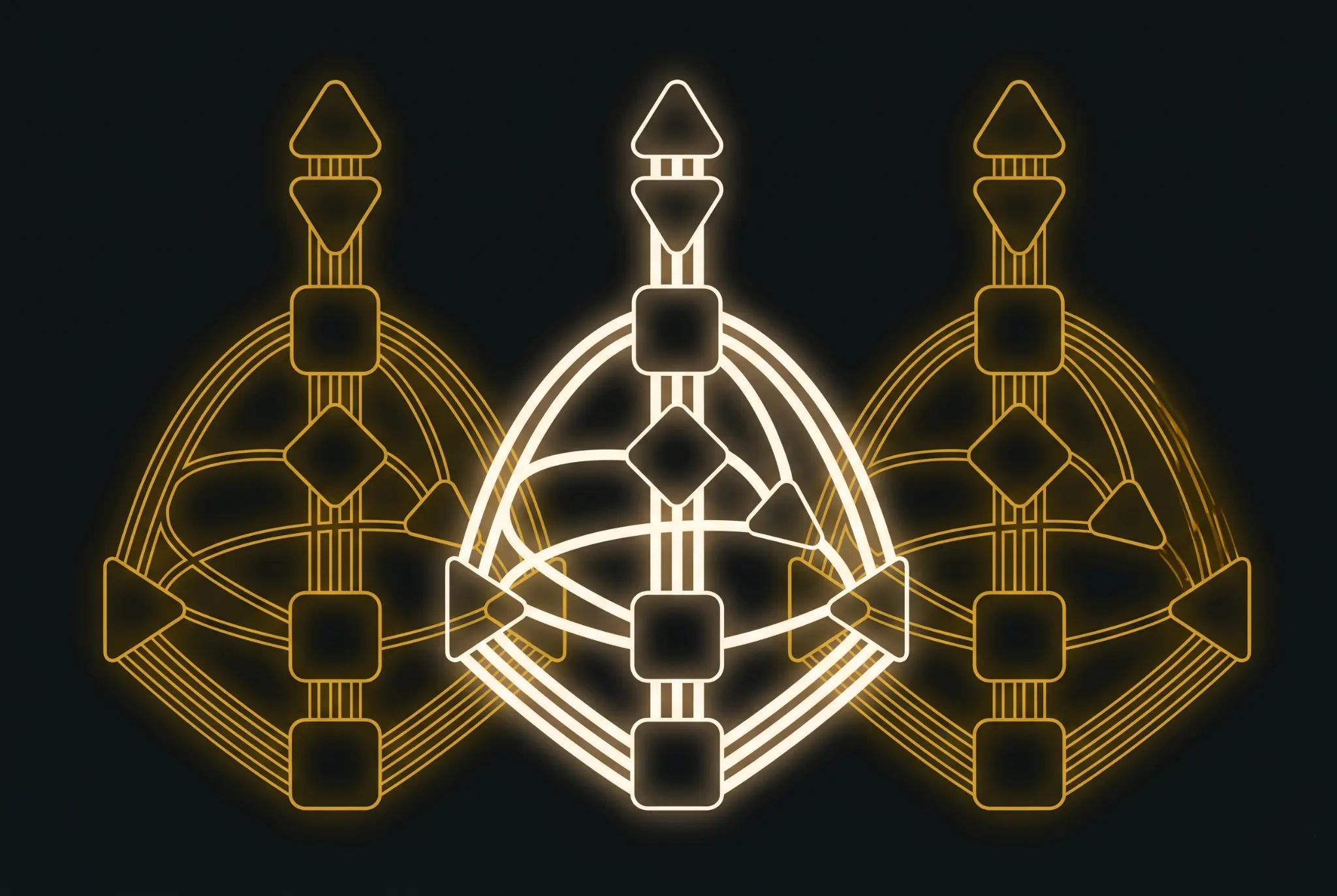

Overlaying two individual charts allows us to observe the elements of Compatibility in Human Design. Have you ever wondered why you instantly click with one person while another seems to make your skin crawl? Sometimes, the exact same phrase can be said verbatim by two different people, and from one it feels charged with an energy that sounds like an attack, while from the other it flows naturally.
It is no surprise that, with certain people, conversations feel like a game of tennis where you hit the ball and the other person returns it. In the same way, we have all experienced what it is like to try to talk to someone and have the conversation die before it even begins, either because the person does not understand us or does not even try. From time to time, people come into our lives who, as if by magic, understand everything we say. It is not by chance that around 93% of our communication is non verbal.
In short
Compatibility elements in Human Design appear when you overlay two charts. The Channels and Gates that complete each other between two people show where the relationship creates something new, where there is attraction and where there is conditioning. They explain why you click with some people and feel friction with others.
1 + 1 = 3
When we look at our Human Design chart, we notice that it contains many different elements. With so many elements, the likelihood of one chart being identical to another is very small, because there are deeper layers that are not immediately visible. This is why even twins born only minutes apart can have different elements in their design. To truly analyse who clicks with us and who does not, it is necessary to analyse a partnership. A partnership is created when we overlay two charts, combining two individual designs to create a third. Human Design does not follow mathematical laws, and 1 + 1 = 3, because the coming together of two energies creates a new energy, while the individual energies still continue to exist. From the joining of the two charts, a theme emerges that influences the way we experience life with that person.
With the overlay of all the elements, if Design A has 5 defined centers and Design B has the other 4 defined centers, the joining of those two charts creates a new one with all centers defined (9-0). The theme here is “Nowhere to go.” This means that within this relationship there is very little space for a third element to enter. Have you ever noticed, at a dinner with several people, that there are two people who cannot detach from each other or let anyone else into their conversation? That is exactly it. There is no room for anyone else. If, on the other hand, the Partnership were left with one undefined center (8-1), the theme would be “Have some fun.” The undefined center is where these two people are able to meet, learn, and have room to grow.
In the same way, if they share the same center, they recognize themselves in each other. If one has a center defined and the other does not, that can be something that causes problems. Let us imagine that one person has a defined Sacral and their partner does not. The being with the defined Sacral will expect their partner to keep up and have energy for everything. However, that is not possible, even if they are amplifying and absorbing Sacral energy, because as soon as they stop receiving that energy, they are most likely to collapse from exhaustion.
Another relevant point is Energy Type. If my Energy Type is Projector and the person I am talking to is too, there are points of affinity that are mirrored and recognized because they are shared. We both have to manage carefully how we use our energy, since it is not infinite, and we both like to be recognized. Does this mean that different Energy Types will not get along well? Of course not, but for that to happen, it is necessary to understand how each one functions, and not everyone has that capacity.
A Projector may very well recognize and feel inspired by a Manifesting Generator who is doing a thousand and one things, but they should also recognize that it would be very difficult to keep up with them. However, if the Manifesting Generator asks for help with something and recognizes the value of the Projector, then of course the latter can guide them and help resolve the steps they skipped while moving at the speed of light.
We can also study compatibility with another person through Profile. If we look at each person’s Profile, we can recognize that when we share the same Profile, there is an immediate click. That is because we share an archetype and know how we tend to act in each situation. If we are both conscious 5th lines, that desire to put on the superhero cape, want to save the whole world, and solve everything will be a shared point of connection. If the affinity is also shared in the unconscious line, for example in the 1st line, both will know how to give the other person space to go deep, research, and study whatever arises in that moment.
Anyone who follows astrology is probably already familiar with the terms North Node and South Node. The North Node points to the shape our life tends to take from the age of 40 onward, while the opposite theme of the South Node relates to what we bring from past lives and tends to remain with us up until around the age of 39. However, in Human Design, what we can observe here are our lines and our affinity. If both people share the same line in a certain aspect, it means they are likely to encounter the same type of people. For example, if both have the 3rd line in the North and South Nodes, then for both of them life will be closely linked to the experiences they have with the people who cross their path.
Channels and Gates as Elements of Compatibility in Human Design
When two charts are overlaid, we can identify whether there is something that may create friction. In Human Design, this characteristic is called compromise, and it happens when one person has a full channel and the other has only one gate.
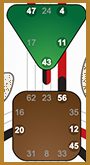
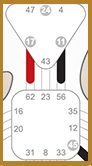
Let us imagine that Person A has the 11-56 channel in their design and is therefore someone who is excellent at creating content and telling stories. At work, Person A shares with Person B, who only has Gate 11 activated, something they have written. Person B offers their opinion, which is the theme of Gate 11, the Gate of Ideas and Opinions, and that opinion may even be good or neutral. However, Person A already has the whole channel energetically and does not need the other person’s opinion at all because they already carry the full energy in their design. At first, this behaviour from Person B may not bother Person A, but over time it will begin to become a point of tension. As with everything in life, the most important thing is to be aware that this compromise exists so that those differences can be worked through.
If there are elements that make our skin crawl, there are also others that bring us together. Companionship happens when two people share the same channel. Sharing a channel brings something that both people recognize in each other. The same applies when the same gates are shared while analysing compatibility in Human Design. When only one person has the full channel, this is called Dominance, and it is where we recognize in the other something that we ourselves do not have.
Finally, there are the Electromagnetic connections, which are as simple as they are beautiful to see and feel in the body. Our Active Gates are also called Hanging Gates, because they are always calling for the opposite Gate, the Harmonic Gate, in order to complete the Channel. It is something that pulls us in, and we do not even know why.
Elements of Compatibility and Individual Conditioning
When we look at the Human Design of two people together and everything connects, all the colours light up, it is like turning on a Christmas tree. In this case, there is a chemical pattern present in which two people are compatible and may play a very important role in each other’s lives. However, too much energy together can also create a short circuit if there is no awareness. In essence, what connects us is the recognition of someone who understands us and feels the same as we do, or who admires us for what we have and can bring to them. There is always a part of us that calls the other.
To observe the level of compatibility in Human Design, it takes more than simply overlaying two charts. It is necessary to understand how 1 + 1 equals 3 and how that third energy can affect each person’s individual conditioning. Human Design is an experience for each of us and, at different stages, that experience can have different effects on the people around us.